Gamified training Games that train real decisions.
qlture builds short missions, team competitions, career mode and rankings from your policies, and runs the whole thing.
Definition
What is gamified training?
Gamified training uses game mechanics such as missions, points, team competition and levels in training and internal campaigns. Each qlture experience starts from your rules: the finance mission is about invoices and suppliers, the customer care one is about a caller asking for someone’s account details.
01 · The repertoire
The seven mechanics we use.



- 01
Decision missions
One-minute scenes.
Short scenes taken from your company’s routine: the invoice someone wants booked in the wrong month, the supplier’s invitation, the résumé posted in the team chat. Whoever plays decides and sees the consequence right away.
What it trainsSpotting the risky moment before it passes.

- 02
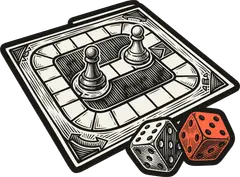
Games
Company rules with game rules.
The games range from quick quizzes to digital board games, with spot-the-error challenges and simulations in between. Each one is designed for one topic and one audience, with a goal, rules and instant feedback.
What it trainsRemembering what matters through practice, without rereading the policy.
- 03
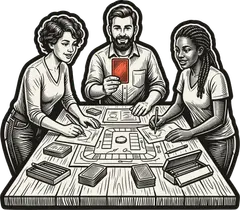
Team competitions
The whole team plays together.
Departments and teams score points for taking part and making good decisions.
What it trainsConversations about the topic inside each team.
- 04
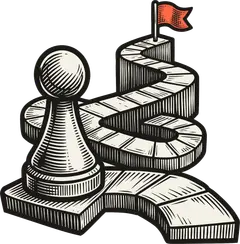
Career mode
Progress in levels.
People move up through levels and roles during the program. Each level brings challenges closer to their job and unlocks new missions.
What it trainsConsistency. Habits grow step by step.
- 05
Rankings and achievements
Recognition for taking part and improving.
Rankings are by team, badges reward behaviors and each season has its own achievements. The criteria reward participation and progress, so people who started behind still have a reason to keep going.
What it trainsA reason to come back.

- 06
Campaigns
One subject at the center, at the right time.
Themed campaigns tie the program to the calendar: Cybersecurity Awareness Month, a health and safety week, an ethics and compliance week, the launch of a new policy. Each one has communication, a challenge and a closing with results.
What it trainsShared attention on a topic when it matters most.

- 07
Champions
A colleague who keeps it going.
Employees from different teams get training, ready-made missions and recognition to answer questions and bring colleagues into the missions. qlture supports the network throughout the program.
What it trainsA familiar face who speaks the team’s language.
02 · Try it
A real mission, in one minute.
Pick a topic and decide. This is how a mission reaches your people, with your company’s situations in place of these.
- Good decisions score points
- Every choice gets feedback
Finance · 4:48 pm
The director is in a hurry.
A new number, with your director’s photo, asks for an urgent payment to a supplier. Their meeting only ends after hours.

A qlture mission looks like this: short and taken from daily work. In the program, the same rule comes back weeks later in another format.
Interactive mission · Demoqlture
03 · Team competitions
Healthy rivalry has rules.
- 01
The score belongs to the team. Nobody shows up alone on the scoreboard for a wrong answer, and mistakes get talked through by the team.
- 02
Average per participant. A team of eight competes on equal terms with a team of eight hundred.
- 03
Taking part and deciding well is what scores. Answering fast earns nothing extra, so people who stop and think before clicking come out ahead.
- 04
The scoreboard resets every cycle. The team that finished last starts the next season level with the leader.
Sample season
Round 03 / 03
- 2Finance410
- 4Sales380
- 3Technology395
- 1Operations430
- 5People350
04 · What the research says
Games help people learn. They do less for behavior.
A meta-analysis by Michael Sailer and Lisa Homner, published in 2020 in Educational Psychology Review, pooled studies that compared learning with and without gamification. The effect was positive on all three outcomes measured, though not equally strong.
- Cognitive learningKnowing what and why.0.4919 studies
- MotivationWanting to take part.0.3616 studies
- BehaviorDoing things differently at work.0.259 studies
The effect on behavior was the smallest of the three and, along with motivation, the least stable across studies. At qlture, the game comes inside an ongoing program.
- Game
opens the conversation and sets the why.
- Mission
takes the decision into real work.
- Cycle
repeats it at intervals, each time in a different disguise.
- Champions
keep the topic going when nobody is playing.
05 · By topic
The same mechanic changes its tone.
In security awareness, a phishing quiz can have a scoreboard. In harassment prevention, the mission asks for quiet reflection. The format follows the topic.
- 01Security awarenessPhishing, social engineering, passwords and access.

- 02Compliance and ethicsCode of conduct, conflicts of interest, integrity.

- 03Privacy and dataPersonal data handled with care, every day.

- 04Harassment preventionPrevention, speak-up channels and respect.

- 05Psychosocial risksMental health and workplace risk management.





Frequently asked questions
About games at work.
01What is corporate gamification?
It is the use of game elements such as points, missions, levels, narrative and competition in work situations that are not games. The goal is to raise participation and support behavior change. Inside a qlture program, it is built from your company’s policies and runs all year.
02What is the difference between gamification and games?
A game is a complete experience with rules, a goal and an end, like a quiz or a simulation. Gamification applies game mechanics to something that is not a game, like giving points to people who report a suspicious email. A qlture program uses both.
03What are the elements of gamification?
The most common are points, levels, missions, rankings, achievements, narrative, instant feedback and competition or collaboration between teams. Each one has to be tied to a behavior: points for reporting make sense, points for clicking fastest do not.
04How do you run team competitions without toxic rivalry?
The four scoreboard rules above were designed for that. In the conversation after each round, the topic is the decision the team made, and nobody gets called out for a colleague’s mistake.
05Does gamified training work for serious topics like compliance and harassment?
In harassment prevention and mental health, the format changes: decision and reflection, with no individual scoreboard, no jokes and clear support paths such as the speak-up channel. Competition stays with the topics where it helps.
06Does gamified training only work with younger employees?
Design matters more than age. What puts anyone off is a childish, long game with no link to their work. qlture missions are short, sober and drawn from each team’s routine.
07Do we need to buy the platform separately?
No. The platform is included in the program, and qlture sets up, publishes and runs the experiences. Your team validates the content and follows the results. See how the program works.
Which decision does your team
need to practice?
Tell us which policy worries you most. We build the mission, the game or the season.
Let’s talk